


I work for Santa.
Not in the “I wore a felt hat at the mall” way. I mean: I have an employee badge that only works if you tap it with a candy cane, I’ve sat through actual reindeer route-planning meetings and I’ve watched a grown man in red velvet calmly resolve a conflict between two toy designers who both thought their dinosaur needed more glitter.
(For the record, neither dinosaur needed more glitter.)
One of them needed fewer opinions.
So yes, this is a leadership piece.
No, there will not be a framework.
And no, I’m not saying you should run your team like a magical surveillance state (we’ll talk about The List later). I’m saying that if you strip away the folklore and look at the way Santa operates, you get a surprisingly solid blueprint for what modern leadership is supposed to look like: clear purpose, consistent values, real accountability and a culture where people can do great work without burning out or turning into jerks.
This alone eliminates about half of middle management.
Also: the snacks are elite.
The dental plan is… aspirational.
HR insists these two facts are unrelated.
Let me explain.
The North Pole has a mission people actually understand
Most organizations struggle to answer one simple question without a PowerPoint:
Why do we exist?
At the North Pole, nobody has that problem.
Mostly because Santa has a visible allergic reaction to PowerPoint.
Last time someone tried, the projector “mysteriously” froze. Forever.

Our mission is painfully clear: bring joy, deliver gifts, be kind, don’t miss Christmas Eve. In that order. Yes, this has been clarified. You can debate the ethics of a global gift monopoly, sure, but you can’t argue the mission is confusing.
That clarity matters because it makes decision-making fast. Also because arguing about priorities in December is considered a fire hazard. When you’re choosing between:
investing in safer sleigh tech,
adding a new line of plush dragons,
or rewriting the cookie policy (again),
…the mission is the tie-breaker. It’s not “what makes the spreadsheet look pretty.” It’s “what helps us deliver joy well.”
Spreadsheets still exist. They are just not in charge.
Modern leadership starts with that kind of clarity. Not a poster. Not a slogan. A purpose your people can repeat without checking Slack.
Mostly because there is no Slack. There is a bell.
And you really don’t want to be the reason it rings twice.
Santa is consistent (which is rarer than you’d think)
Santa is the same person in the workshop, in a storm, in front of a camera or sitting with a nervous new elf who just glued their sleeve to a teddy bear.
That elf is doing fine now. Emotionally, I mean.
The teddy bear never fully recovered.

That consistency is a bigger deal than it sounds.
Especially to people who have worked literally anywhere else.
Because teams don’t just watch what leaders say, they watch what leaders tolerate, what they reward and what they do when they’re tired, stressed or under pressure.
Christmas Eve is pressure.
It is also very loud.
And smells faintly of ozone and panic.
And Santa doesn’t turn into a different person when the stakes go up.
Which is impressive for someone who hasn’t slept since mid-December.
The “Naughty or Nice” thing is… not what you think
Okay. We have to address it.
Yes, there’s a list. Yes, it’s checked twice. No, I can’t show you the dashboard.
Partly because it doesn’t exist. Partly because I like my job.
And partly because you wouldn’t believe the filter settings.
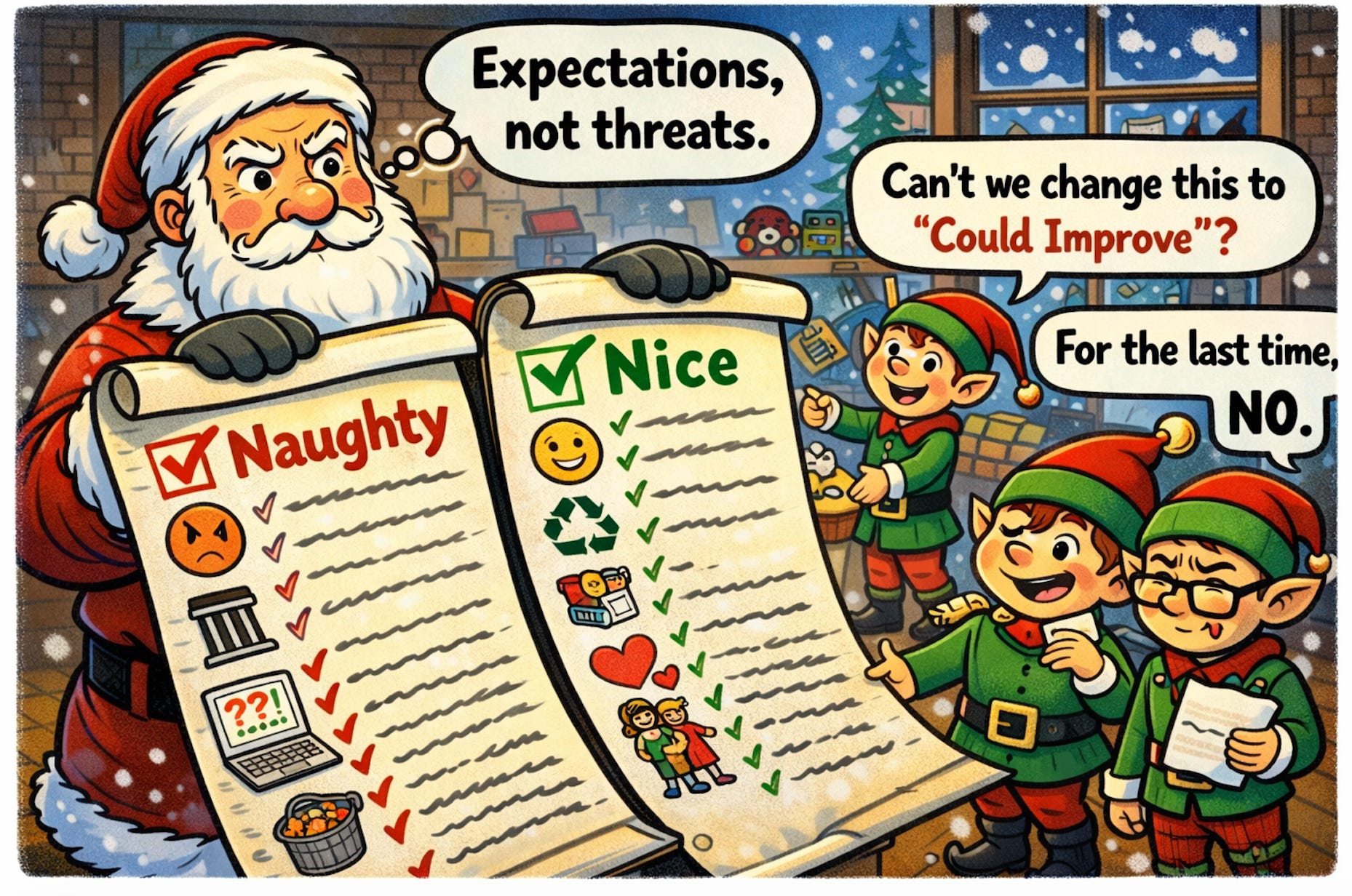
But here’s the part people miss: inside the organization, Santa doesn’t lead with fear. He leads with expectations.
The list isn’t a threat. It’s a standard. It’s the clearest form of “this is what good looks like” you’ll ever see.
Think less “villain monologue,” more “performance review, but shorter.”
Now, do I personally think the brand messaging could use a refresh? Absolutely. “Naughty” is a bit… 16th century.
There have been internal debates. They went nowhere.
Rebranding died somewhere between Legal and Tradition.
But the leadership lesson stands:
Good leaders make expectations explicit. Bad leaders let everyone guess, then punish them for guessing wrong.
He’s basically a Servant Leader (and it’s not just the beard)
There’s a leadership idea called servant leadership. The core notion is that a leader’s job is to serve the people doing the work, not the other way around.
Santa is that, in practice.
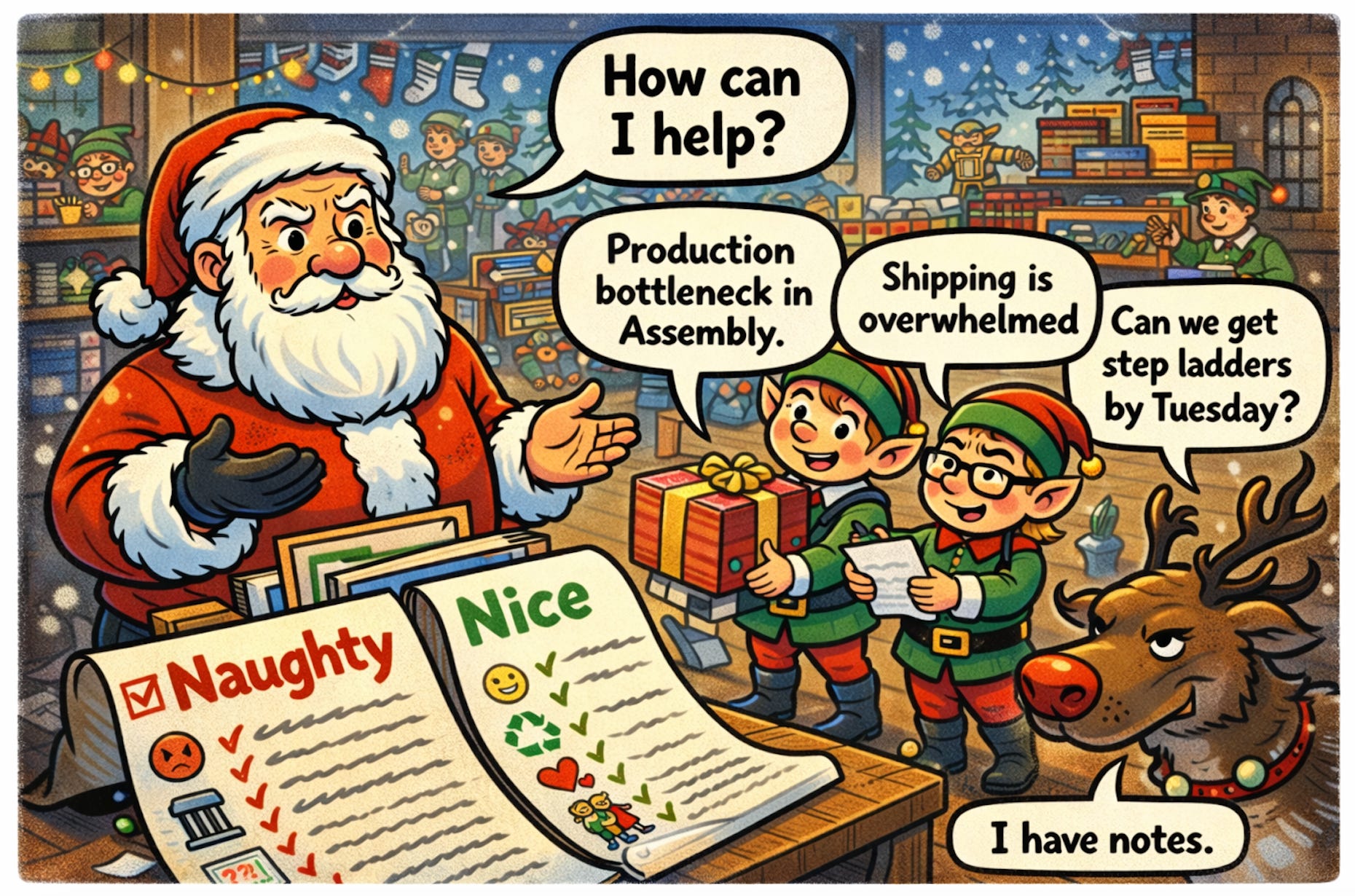
His entire role exists to support a massive effort carried by thousands of elves, plus a small but emotionally sensitive reindeer team. He clears obstacles. He protects the mission. He absorbs the heat when things go wrong.
Especially from Donner. Donner holds grudges.
Blitzen pretends not to, which is worse.
And here’s the part I didn’t appreciate until I’d worked elsewhere:
Santa never confuses “being in charge” with “being the point.”
This alone should disqualify at least three people you know.
That’s modern leadership in one sentence.
Psychological Safety: Yes, even in a place with candy canes for door handles
Psychological safety is when you can say,
“Hey… I think the doll’s eyes are upside down,”
without worrying you’ll be publicly roasted, frozen out or assigned to permanent stocking-stuffer duty.
Which is real and deeply boring work.
You wrap things for people who did nothing wrong.
Santa is exceptionally good at this.
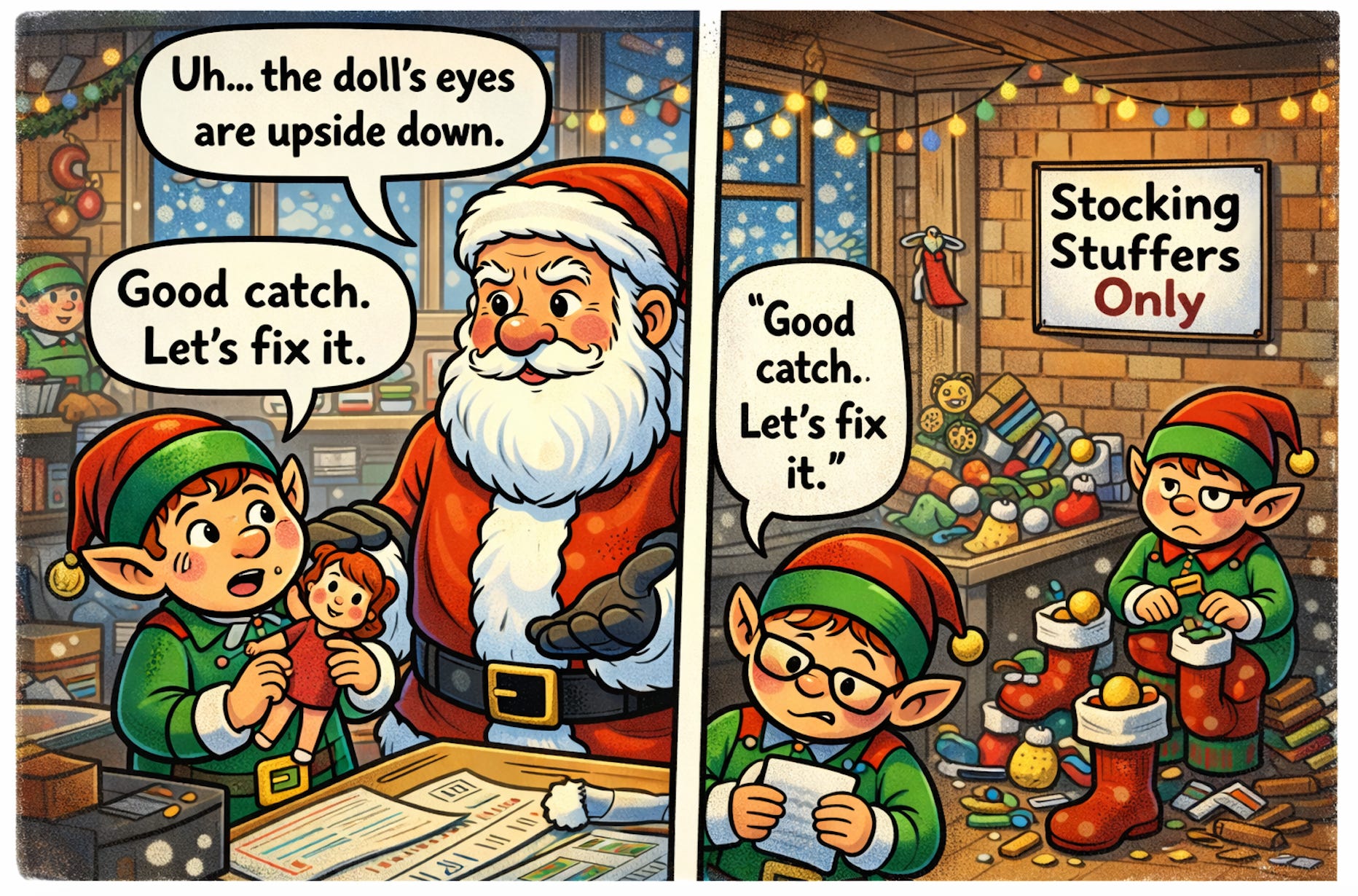
When a junior elf flags an issue, Santa doesn’t punish the messenger. He says:
“Good catch. Let’s fix it.”
He does not say, “Why didn’t you catch this sooner?” which is leadership, actually.
That one habit prevents disasters and builds a culture where people speak up early, before the mistake becomes 600,000 upside-down-eyed dolls shipped worldwide.
This has never happened. Hypothetically.
A lot of leaders say they want honesty. Santa actually makes it safe.
He’s weirdly transparent for a guy who lives at the North Pole
One of the most underrated leadership skills is managing stakeholders without spinning them.
Santa does this with the entire planet.
Which is exhausting, even with magic.
Especially adults who insist they are “just asking questions.”
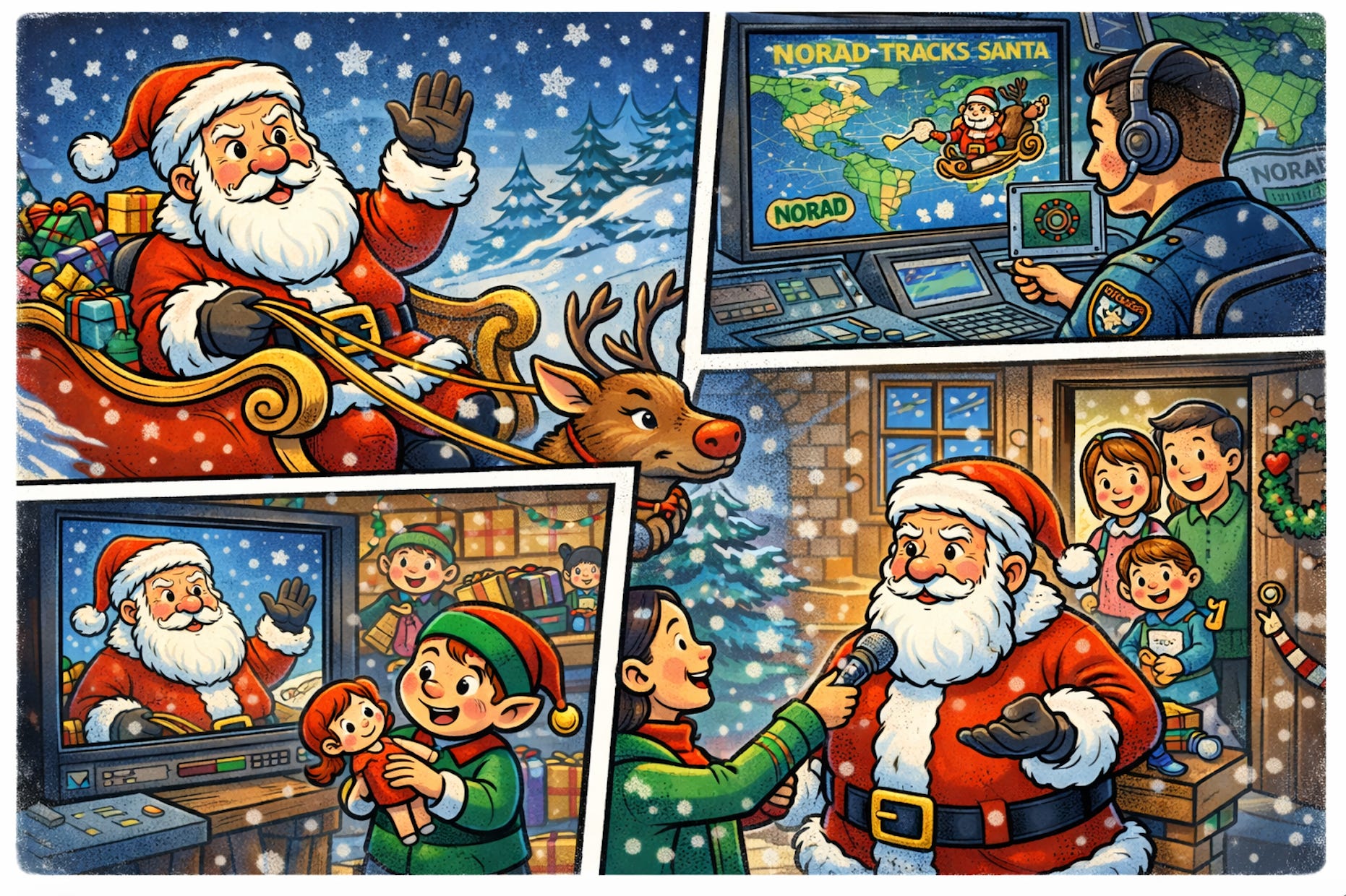
Whether you see NORAD tracking the sleigh as PR, tradition or a holiday miracle of customer support, the takeaway is the same:
Santa meets people where they are. He communicates in a way they trust. He makes the invisible visible.
Most leaders could improve morale by doing 5% of that.
Even 3% would help.
He protects the culture like it’s the only thing that actually matters (because it is)
Here’s a secret: the workshop runs on culture more than magic.
Magic helps, but culture survives budget cuts.
Culture is how you behave when nobody’s watching.
Which is surprisingly often. We have corners.
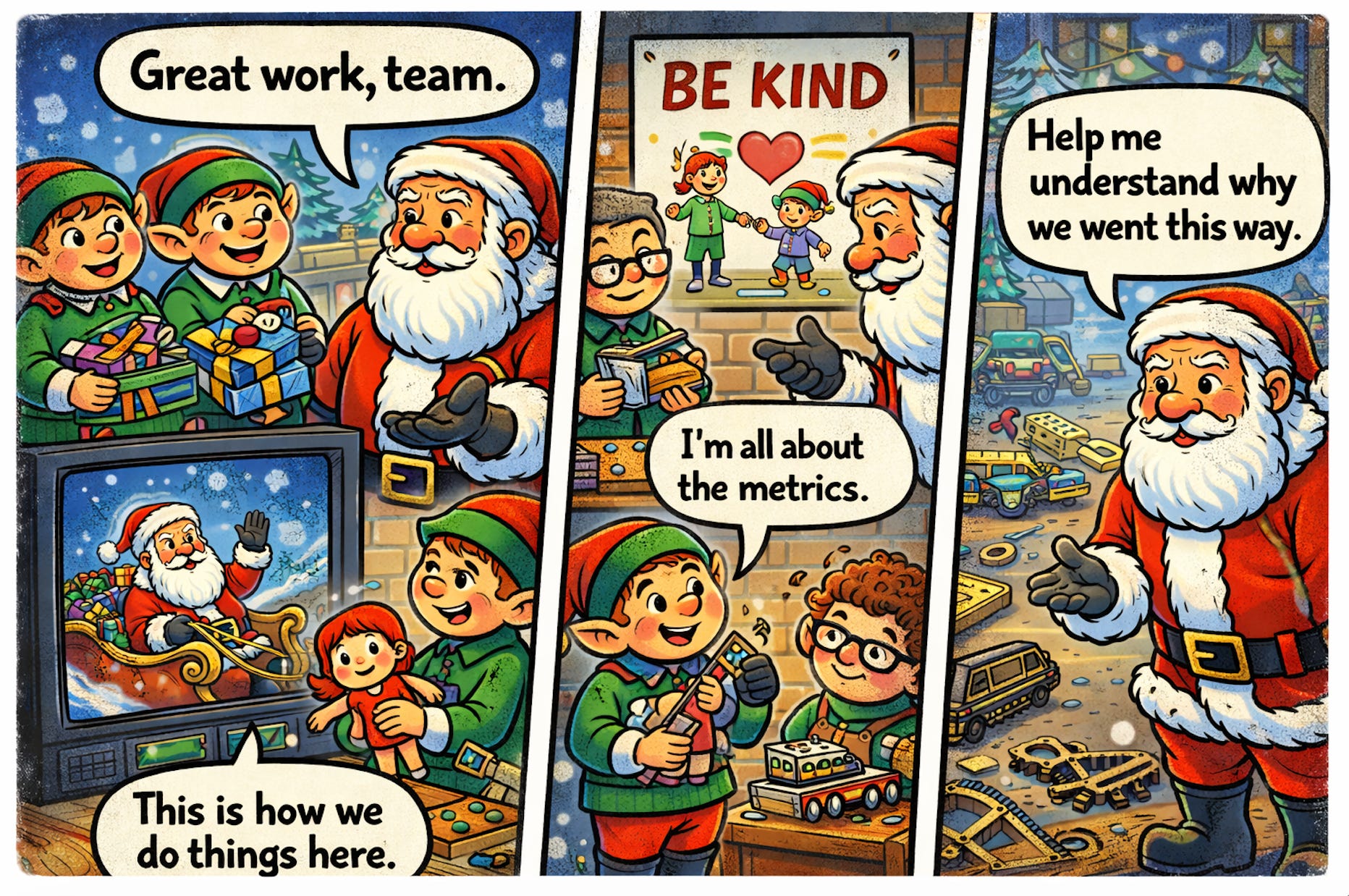
Santa reinforces the culture in small, consistent ways:
He credits teams, not himself.
He treats “kindness” as a performance expectation, not a poster.
He doesn’t let high performers be toxic. (Yes, even if they make excellent train sets.)
Especially if you remind everyone of this fact. Constantly.
And he never pretends curiosity is weakness.
He asks questions. Some of them are inconvenient.
The biggest misunderstanding about Santa’s leadership
All of this leads to a bigger misunderstanding…
People think Santa’s leadership is all about results: one night, impossible deadline, perfect delivery.
But the reality is the opposite.
The delivery is the output. The leadership is the system.
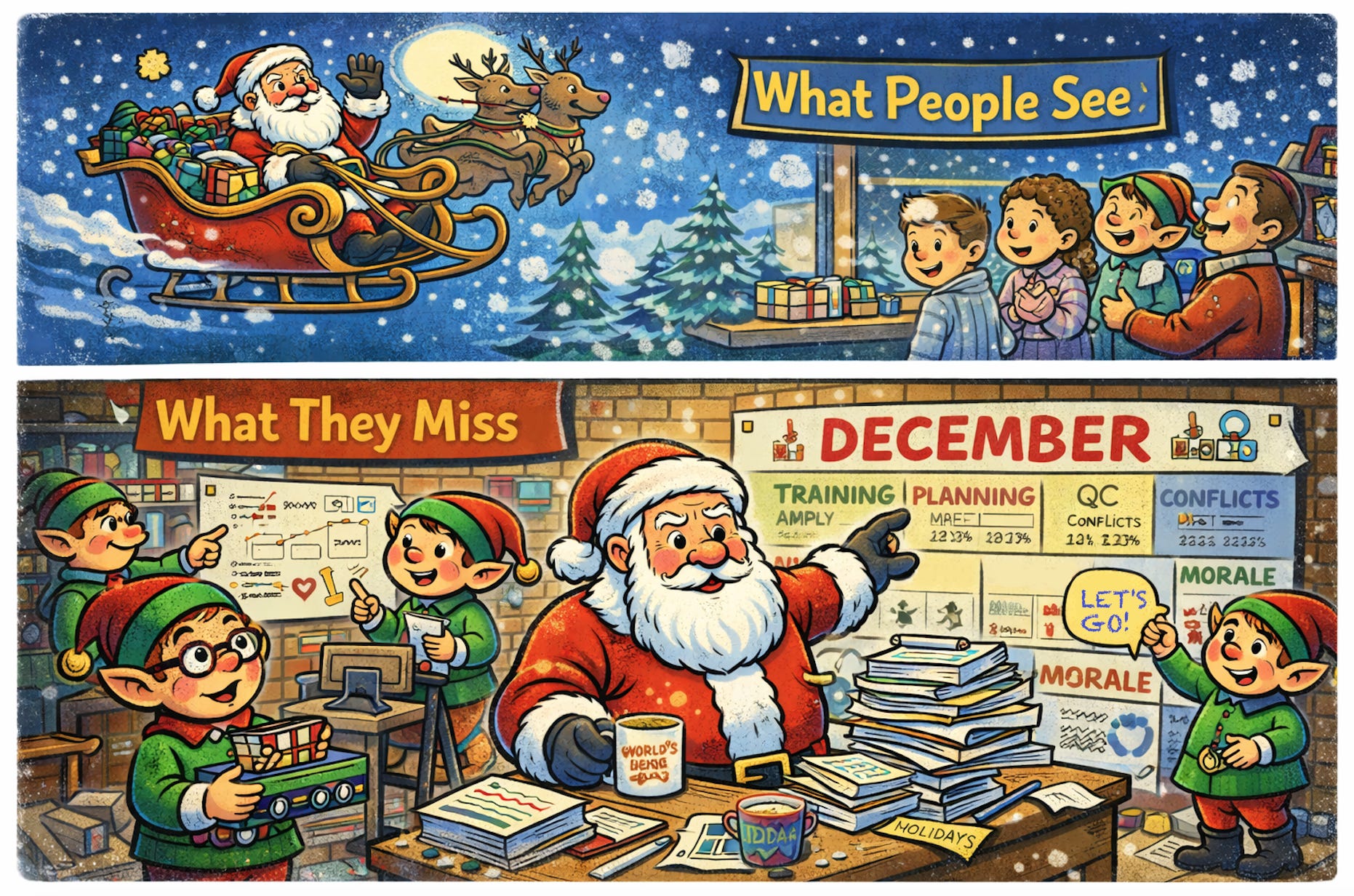
It’s the 11 months of training, planning, quality control, conflict resolution, morale management and making sure nobody loses their mind in late November.
December is already too late.
That’s the difference between luck and leadership.
Final thoughts from an elf with glitter in their hair
Santa’s leadership isn’t perfect. (Don’t get me started on the cookie crumbs in shared workspaces.)
Or the mugs that say “World’s Best Boss.” There are several.
But year after year, he pulls off something that most leaders only talk about.
He aligns people around a clear purpose.
He makes it safe to speak up.
He serves the mission by serving the team.
He holds standards without becoming a tyrant.
And he stays human, even when the operation is mythically huge.
Also: the man writes thank-you notes. Handwritten.
We suspect Mrs. Claus forces this. We do not ask questions.
We like our pensions.
Anyway. If you ever find yourself wondering what “good leadership” looks like, imagine this:
It’s 3:17 a.m. on December 24th. The sleigh is loaded. The weather is nasty.

A leader steps outside, looks at the team and says:
“We’ve got this. And we’re doing it together.”
That’s Santa.